Your Favorite Superhero Is Now a Puppet: How Motion-Capture Ate the Soul Out of Blockbuster Acting
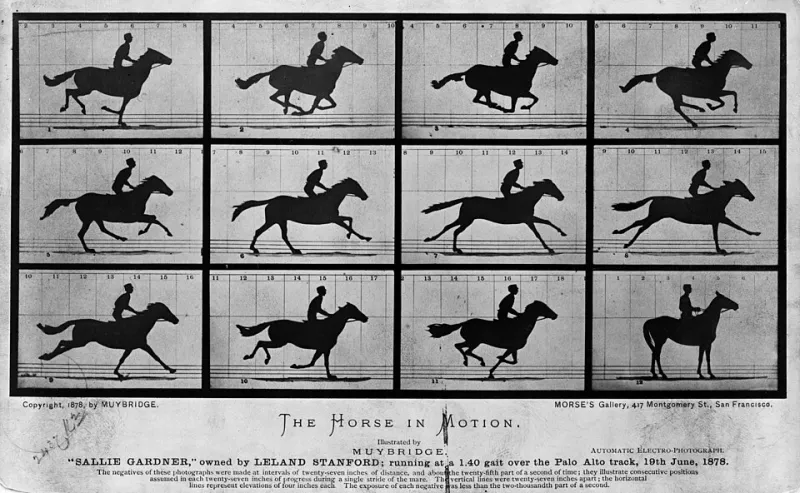
Photo: Eadweard Muybridge, Public domain, via Wikimedia Commons
Let's get one thing straight before we start: motion-capture technology is genuinely impressive. The engineers and animators who spend years perfecting these tools are talented, hardworking people doing extraordinary things with math and light and computing power that would have made Stanley Kubrick weep into his storyboards. This is not their fault.
This is a story about what happens when studios confuse capability with craft — and why your favorite superhero increasingly looks like a very expensive video game cutscene wearing a human face.
The Dots on the Suit Are Not the Performance
Here's a thought experiment. Think about the last superhero blockbuster you watched where an actor delivered a line that genuinely gutted you. Not a quip. Not a callback to something from Phase One. A real, lived-in, human moment that made you feel something in your chest.
Now ask yourself: was that actor wearing a motion-capture suit when they shot it?
Probably not. Probably it was a quieter scene. Two people in a room. Maybe a hospital. Maybe a kitchen. Somewhere the budget wasn't eating the frame alive.
The uncomfortable truth lurking beneath every Marvel and DC press junket is that the scenes audiences remember — the ones that get clipped and rewatched and turned into reaction videos — are almost never the ones costing $40 million per minute to render. They're the in-between moments. The human ones. And those are exactly the moments that get crowded out when a franchise is structurally obligated to spend its third act inside a digital hurricane.
When the Rendering Farm Becomes the Director
Andy Serkis has been making this argument for twenty years, and he's been largely ignored for twenty years, which tracks. The man built an entire second career out of performing in a ping-pong ball suit and watching studios debate whether his work counted as acting. (Spoiler: it absolutely does. Gollum is a more fully realized character than half the leads in the MCU's Phase Four slate, and that's not even a spicy take anymore.)
But Serkis's situation is actually the best case scenario — a director who understood that the technology was a vessel for performance, not a substitute for it. What's happening now in the broader superhero industrial complex is something far more corrosive.
Actors are being asked to perform against green screens, in isolation, responding to tennis balls on sticks, delivering emotional beats to empty air — and then watching those performances get smoothed, adjusted, and occasionally replaced in post-production by digital doubles that the studio has more control over. Because a digital double doesn't need a trailer. It doesn't have opinions. It will hold whatever pose the marketing department needs for the toy packaging.
This is not a conspiracy theory. It's a workflow. And it has consequences.
The Uncanny Valley Has a New Address and It's Your Multiplex
Remember when the Uncanny Valley was a problem about faces? Early CGI humans looked wrong because the eyes didn't move right, the skin didn't catch light correctly, the micro-expressions were slightly off in ways your brain couldn't name but your gut absolutely could. Studios spent a decade solving that specific problem.
What they didn't solve — what they arguably made worse — is the emotional uncanny valley. The moment where a technically flawless digital performance feels hollow because there's no actual human decision-making underneath it. No actor choosing to hold a beat half a second longer. No instinct. No accident. No risk.
Think about the difference between Tobey Maguire's face in the rain during the cemetery scene in Spider-Man 2 — genuinely awkward, genuinely sad, deeply uncool in a way that somehow worked — versus watching a motion-captured hero register grief through a face that's been optimized for every demographic simultaneously. One of those things is a performance. The other is emotional content delivery.
The Actors Know It Too
They won't say it on the press tour. They've got three more films on the contract and a piece of the backend and a very nice house in Los Feliz. But read between the lines of enough interviews and you start noticing a pattern.
Actors talk about the other scenes. The quiet ones. The ones that almost got cut. They light up describing the moments between the action sequences, the character work they had to fight to keep in, the director who let them improvise something small in scene four that became the emotional key to the whole movie. They are, without quite saying it out loud, telling you exactly where the real performance lives — and it is not inside the CGI tornado.
Even franchise veterans who've built careers inside these machines occasionally slip. They describe the disorientation of performing against nothing, the difficulty of sustaining genuine emotional truth when your scene partner is a placeholder and your costume is a gray onesie covered in tracking markers. This is not a complaint about their paychecks. This is a genuine craft problem that the industry has decided to treat as a technical problem — and those are not the same thing.
What Gets Lost in the Render
Here's what motion-capture does brilliantly: it captures broad physical performance. Exaggerated movement. Action choreography. The kind of physicality that would be impossible or dangerous to shoot practically. For that specific use case, it's extraordinary.
Here's what it does badly: it smooths out the weird. The imperfect. The accidentally true. The half-second where an actor's face does something the director didn't ask for and couldn't have scripted but is somehow the most honest thing in the film. Digital processing has a bias toward the legible, the clean, the marketable. It is structurally allergic to the kind of raw, slightly wrong human moment that makes a performance stick in your memory for twenty years.
Studio executives talk about technological advancement like it's morally neutral — just better tools, better outcomes. But every tool encodes a set of priorities. And the priority baked into the motion-capture pipeline, at the scale these franchises operate, is control. Control over the image, the brand, the asset. The actor, in this framework, is raw material. The performance is a starting point. What gets to the screen is whatever survives the pipeline.
Give Us the Imperfect Version
The superhero genre is not going to abandon CGI. That argument was lost somewhere around 2012 and nobody's getting the deposit back. But there's a version of this conversation that isn't about going backward — it's about insisting that the technology serve the performance instead of consuming it.
The best moments in superhero cinema — the ones that made the genre worth caring about in the first place — happened when a human being did something unexpected in front of a camera and the film was smart enough to keep it. That's still possible. It's just increasingly inconvenient for the pipeline.
Somewhere in a rendering farm right now, a $180 million version of someone's face is being optimized for global release. And the actual actor who provided the reference performance is at home, watching dailies, wondering what happened to the take they thought was the one.
They were probably right.